Automatic Shutter Systems for Growing Industrial Hubs in Pune

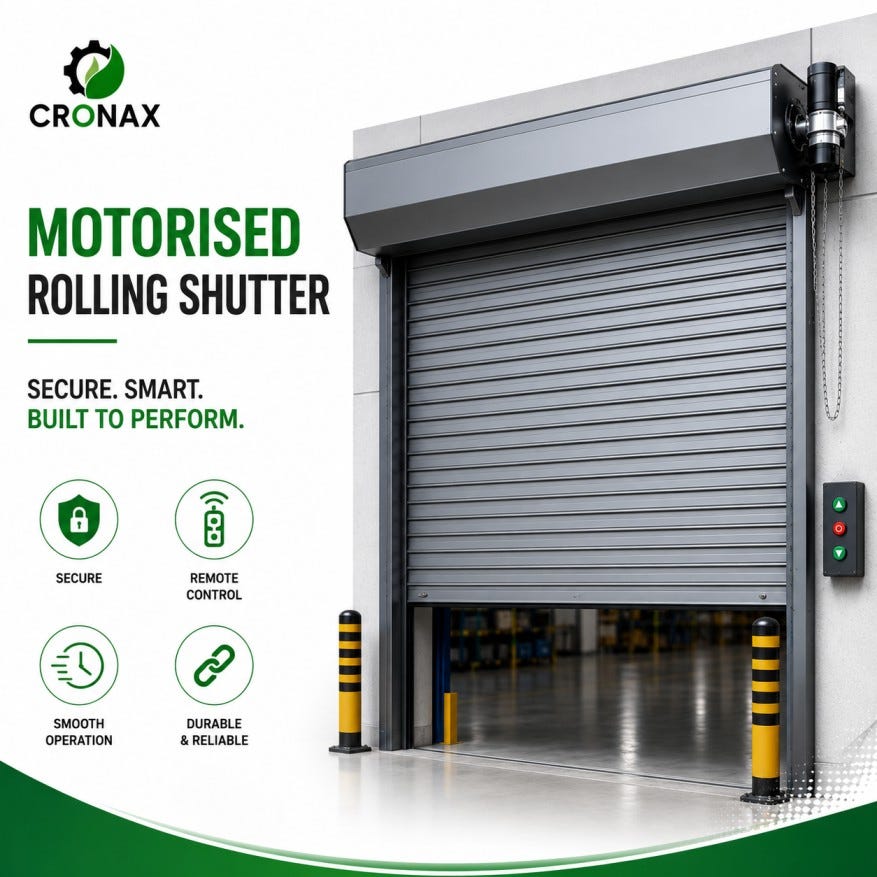
Pune isn’t the same industrial city it was ten years ago.
Chakan MIDC has become one of Maharashtra’s most active automotive and manufacturing corridors. Bhosari, Pimpri-Chinchwad, Talegaon, and Hinjewadi are running at a pace that demands infrastructure to match. New warehouses, EV component plants, pharmaceutical units, and logistics centres are coming up across the Pune-Mumbai Industrial Corridor at a rate the city hasn’t seen before.
And in almost every one of these facilities, there’s a door that opens and closes dozens of times a day — sometimes hundreds. That door is the first line of operational security and the last line of access control. Getting it wrong has real consequences.
Most newer Pune industrial facilities are specifying automatic rolling shutters from the start. Older ones are retrofitting. The shift is not driven by preference — it’s driven by the practical reality that manual shutters can’t keep up with what modern industrial operations in Pune demand.
What’s Changed in Pune’s Industrial Landscape
Pune’s growth over the last decade has been specific and fast.
The automotive sector — Tata Motors, Bajaj Auto, Force Motors, and their tier-1 and tier-2 suppliers — built the foundation. Then came electronics, pharmaceutical manufacturing, defence component production, and now electric vehicle supply chain facilities clustering around Chakan and Talegaon.
These aren’t small operations. They run multiple shifts. They handle expensive goods and sensitive materials. They have contractor vehicles, raw material trucks, and finished goods dispatches moving through entry points around the clock.
A manual shutter in this environment is a mismatch. It depends on a person to operate it correctly every single time. It slows down every vehicle movement by the time it takes to open and close manually. It creates access control gaps when it’s left open. And it wears out faster under the cycle counts that busy Pune industrial facilities generate.
An automatic rolling shutter removes these variables — not as a luxury, but as a practical operational necessity for facilities running at modern industrial pace.
The Security Case — More Specific Than It Sounds
“Security” is the first reason most people give for installing a motorized rolling shutter. But the security benefit in an industrial context is more specific than just “the door is harder to open.”
Consistent closure. A manual shutter is only as secure as the last person who closed it. In a Pune factory running three shifts, that person changes. Their diligence changes. End-of-shift fatigue is real. An automatic rolling shutter closes completely and correctly every cycle — independent of who’s operating it or how tired they are.
Access control integration. Modern automatic roller shutter doors integrate with access control systems — RFID readers, vehicle loop detectors, security keypads, intercom systems. The shutter only opens when the right credential is presented. Every entry and exit is logged. For pharmaceutical facilities and defence component manufacturers in Chakan and Bhosari — where who enters the facility is a compliance matter — this logging capability is not optional.
After-hours protection. A motorized shutter with a timer control closes at a programmed time regardless of what’s happening on the floor. An alert goes to the security system if the shutter remains open past its scheduled close time. For multi-site industrial operators managing several Pune-area plants from a central control room, this remote visibility across all locations is genuinely valuable.
Forced entry resistance. A motorized rolling shutter under motor tension holds more firmly against forced lifting than a manual shutter sitting on its own weight. The motor drive adds resistance that’s particularly relevant for high-value material storage areas and finished goods dispatch zones.
The Operational Case — Where Industrial Facilities Actually Feel the Difference
Security is the justification. Daily operations is where the benefit is actually felt.
A delivery truck pulls up at a Chakan auto component plant. With a manual shutter, the security guard walks to the control point, the driver gets out or honks, the guard operates the shutter, the truck enters, the guard closes the shutter again. Four to six manual steps for every vehicle movement.
With an automatic rolling shutter integrated with a loop detector, the truck triggers the sensor as it approaches. The shutter opens. The truck enters. The shutter closes. Zero manual steps. The guard focuses on verification and documentation rather than shutter operation.
For a facility handling 40 to 60 vehicle movements per shift, this difference compounds. The time recovered from eliminating manual shutter operation is not dramatic in any single instance. Across a full shift, across every operating day of the year, it’s a real operational efficiency gain.
It also reduces the queuing that happens when vehicles stack up behind a slow manual operation. For pharmaceutical cold chain distribution in Hadapsar or food processing dispatch in Ranjangaon — where vehicle dwell time at the gate affects the integrity of temperature-sensitive products — this queuing reduction has direct product quality implications.
Pune’s Climate — What It Does to Shutters
This is a local factor that’s worth addressing specifically.
Pune’s climate is generally considered moderate compared to Rajasthan or Gujarat. But moderate doesn’t mean easy on industrial equipment.
Monsoon season — June through September — brings humidity and water exposure that accelerates corrosion on poorly finished steel components. The monsoon wind can be aggressive, applying load to large shutter faces that reveals structural weaknesses in undersized installations.
Summer pre-monsoon months bring heat and dust from the Deccan Plateau — relevant for industrial areas on Pune’s periphery where road surfaces and construction activity generate significant airborne particulate that gets into door mechanisms.
For automatic rolling shutters in Pune’s industrial areas, these conditions mean:
Material specification matters. Galvanised steel or powder-coated mild steel is the baseline for most Pune applications. For facilities within the city’s more humid zones or near Bhosari’s heavier industrial activity, better surface treatment pays back in longevity.
Motor housing protection matters. Control panels and motor housings on exterior installations need IP-rated enclosures — protection against the monsoon rain and humidity that would corrode an unprotected installation within a few seasons.
Spring and mechanism quality matters. Poorly specified counterbalance springs fail faster under the thermal cycling of Pune’s seasonal temperature variation than properly rated components. This is where low-price installations reveal their true cost — in the service calls that follow.
Types of Automatic Rolling Shutters for Pune Industrial Applications
MS Galvanised Steel — standard industrial. The workhorse specification for factories, warehouses, and loading dock entries across Pune’s MIDC areas. Heavy-duty slat profile, galvanised surface treatment, motorised operation with remote and push-button control. The right choice for most standard industrial entry points.
Aluminium rolling shutters. Lighter weight, corrosion-free, and aesthetically cleaner than steel. The right specification for pharmaceutical facilities, food processing entries, and showroom-facing commercial installations where appearance matters alongside function.
Stainless steel rolling shutters. For pharma, food processing, and chemical facilities where hygiene standards require non-corrosive surfaces that can be cleaned with chemical agents. Higher upfront cost, significantly longer service life in demanding environments.
Polycarbonate / transparent shutters. For areas where visibility into the secured zone is required even when the shutter is closed — quality inspection areas, showroom sections within larger industrial complexes, areas where CCTV monitoring needs clear sightlines.
Fire-rated automatic rolling shutters. For fire compartmentalization requirements mandated by NBC 2016 and local fire safety codes. Integrated with the building’s fire alarm system — the shutter closes automatically on alarm activation. Relevant for paint shops, chemical storage areas, and any facility where fire safety compartmentalization is a regulatory requirement.
Insulated rolling shutters. For cold storage entries, refrigerated dispatch areas, and temperature-controlled production zones where the shutter panel itself needs to contribute thermal insulation value alongside fast operation.
Control Options for Pune Industrial Facilities
The control system is what makes an automatic rolling shutter genuinely useful rather than just motorised.
Remote control — the standard. Open and close from inside a vehicle without anyone getting out. Essential for truck drivers at loading bays, forklift operators at internal zone entries, and security personnel managing vehicle access.
Push-button wall switch — for fixed operating positions. Security guard posts, dispatch manager stations, loading dock control panels.
Vehicle loop detector — embedded in the floor approach, detects vehicle presence and triggers automatic opening. For high-traffic loading bay entries where continuous manual activation would be impractical.
Access card or RFID — for controlled vehicle access where only authorised vehicles should enter. Relevant for pharmaceutical facilities and defence-related manufacturers in Pune where access documentation is a compliance requirement.
Timer control — opens at shift start, closes at shift end. Consistent operation independent of human action. Useful for facilities where gate operation needs to follow a defined schedule without manual intervention.
Smartphone and remote monitoring — for multi-site operators managing several Pune-area plants, remote visibility into shutter status across all locations through a connected system.
Cronax Industries — Automatic Rolling Shutters for Pune’s Industrial Needs
For Pune’s growing industrial facilities looking for motorized rolling shutters and automatic roller shutter doors from a manufacturer who understands the application and the local environment, Cronax Industries is worth engaging directly.
Cronax Industries manufactures automatic rolling shutters across the full range required by Pune’s industrial sector — MS galvanised, aluminium, stainless steel, polycarbonate, fire-rated, and insulated configurations. Every installation is motorised with properly rated drives — matched to the shutter weight with adequate headroom, not sized to the minimum that works on a demo.
Control systems cover remote, push-button, loop detector, RFID, timer, and smartphone integration options — specified based on the actual operational requirements of each entry point rather than a standard package.
Manual override is standard on every Cronax installation. Power cuts in Pune’s industrial areas happen. A motorised shutter that jams during a power interruption creates an immediate operational problem. Cronax’s battery backup and manual override ensure the door continues operating and can be managed safely regardless of power supply status.
For Pune pharmaceutical and food processing facilities with specific material requirements — SS 304 shutters, hygiene-rated finishes, or clean-installation protocols — Cronax has the manufacturing capability and the compliance understanding to deliver correctly.
After-sales support across Pune and MIDC areas means service access when it’s needed — not a centralised response team that treats Pune as a peripheral location.
The Practical Decision for Pune Facility Managers
The choice between manual and automatic rolling shutters in a Pune industrial facility comes down to one question: what is this shutter’s actual job?
If the answer is occasional access to a low-traffic storage area with minimal security requirements — manual may be sufficient.
If the answer is managing vehicle access across multiple shifts, maintaining access logs, ensuring consistent closure, integrating with security systems, and handling the operational volume of a modern Pune industrial facility — automatic rolling shutters are the correct specification.
Pune’s industrial growth trajectory is not slowing down. The infrastructure built into these facilities now — including access control and security systems — will determine operational efficiency and security posture for the next 15 to 20 years.
Getting the shutter specification right before installation is easier and cheaper than retrofitting after operations have started.
Cronax Industries helps Pune industrial facilities get this right.
Looking for automatic rolling shutters or motorized rolling shutter solutions for your Pune industrial facility? Talk to Cronax Industries about the right specification for your entry points, security requirements, and control preferences.